If you've ever looked at your Honda CR-V's tires and wondered whether going wider would give you better grip, a tougher look, or improved handling, you're not alone. The question of Honda CR-V stock tire size vs wider tire comparison comes up constantly among owners who want more from their crossover without hurting its daily drivability. Picking the wrong size can lead to rubbing, worse gas mileage, and even safety problems so it's worth understanding what you're getting into before you buy.
What tire size does the Honda CR-V come with from the factory?
Honda ships the CR-V with different tire sizes depending on the year and trim level. Most recent models use 235/65R17 or 235/60R18 tires. Older generations, like the third-gen CR-V (2007–2011), often came with 225/65R17 tires. The width measurement (the first number in that sequence) tells you how wide the tire is in millimeters.
These stock sizes are chosen by Honda engineers to balance ride comfort, fuel efficiency, road noise, and handling. If you want the full factory specifications for your specific model year, you can review the complete stock tire size and specifications breakdown we've put together.
What does "going wider" actually mean?
When people talk about wider tires for the CR-V, they usually mean increasing the section width the first number in the tire code. For example, moving from a stock 235mm tire to a 245mm or 255mm tire. This doesn't just make the tire physically wider on the ground. It also changes the sidewall height (if you keep the same aspect ratio), which affects the overall diameter of the tire.
A wider tire means a larger contact patch more rubber touching the road at any given moment. That sounds great, but it comes with trade-offs that matter for a crossover designed primarily as a family vehicle.
Can you put wider tires on a Honda CR-V without any modifications?
In most cases, yes but only within reason. Going from a 235 to a 245 on the same rim width is usually safe and doesn't require any fender trimming or suspension changes. Moving to something much wider, like a 265, often causes problems. The tire may rub against the inner fender liner, the strut, or the wheel well during turns or when the suspension compresses.
The rim width matters just as much as the tire width. A rim that's too narrow for a wide tire will cause uneven wear and poor handling. A rim that's too wide can cause the tire bead to seat improperly. Most CR-V stock rims (7 to 7.5 inches wide) can safely handle tires in the 225–245 range. Anything beyond that usually requires a wider wheel.
How do wider tires affect fuel economy on the CR-V?
Wider tires create more rolling resistance. More rubber on the road means the engine has to work harder to keep the vehicle moving. On average, owners who go from a 235 to a 255 tire report a 1–3 MPG drop in fuel economy. It's not dramatic, but it adds up over time especially if you drive a lot of highway miles.
Weight also plays a role. Wider tires and larger wheels are usually heavier than stock, which adds unsprung weight. This affects acceleration, braking distance, and fuel consumption. If gas mileage is a priority for you, going more than one size up from stock is probably not worth it.
Do wider tires improve handling and grip?
They can, but the improvement depends on the road conditions. On dry pavement, a wider tire gives you more lateral grip during cornering. You'll feel the difference most in sharp turns and emergency maneuvers. On wet roads, though, a wider tire can actually perform worse than stock if it doesn't have the right tread pattern for water evacuation. A wider contact patch means more risk of hydroplaning if the tread channels aren't designed to move water out efficiently.
For snow and ice, narrower tires are generally better because they put more pressure per square inch on the surface, cutting through snow instead of floating on top. This is one reason why CR-V owners in northern climates sometimes go narrower for winter tires instead of wider.
What are the real pros and cons of upsizing your CR-V tires?
Pros of wider tires:
- More dry-road grip during cornering
- Aggressive, sportier appearance
- Slightly better braking on dry pavement
- More tire options in popular wider sizes
Cons of wider tires:
- Reduced fuel economy
- Potential fender rubbing if you go too wide
- Hydroplaning risk increases in heavy rain
- Faster wear on suspension components due to added weight
- Higher purchase price per tire
- Road noise may increase
For a detailed side-by-side look at specific size combinations, our wider tire comparison for the CR-V covers real-world differences owners have reported.
What's the widest tire that fits a CR-V without rubbing?
For most CR-V model years with stock rims:
- 17-inch stock rims (7" wide): 245/65R17 is usually the max before rubbing becomes an issue
- 18-inch stock rims (7.5" wide): 245/60R18 fits comfortably on most trims
- 19-inch aftermarket rims: 245/55R19 or 255/50R19 with the right offset
These are general guidelines. The actual limit depends on your specific model year, suspension setup, and wheel offset. Always check the clearance at full steering lock and with the suspension compressed before committing to a size.
What common mistakes do people make when going wider?
Ignoring the overall diameter. If you increase width but keep the same aspect ratio, the tire gets taller. A tire that's too tall can throw off your speedometer, affect ABS calibration, and even rub on the fender at full compression. You need to adjust the aspect ratio to keep the overall diameter close to stock.
Only thinking about width. Tire width is one variable. Tread compound, sidewall stiffness, and tread pattern affect real-world performance much more than a 10mm difference in width. A high-quality 235 tire will outperform a cheap 255 tire in almost every measurable category.
Forgetting about the spare tire. Your CR-V's spare is sized to match the stock tires. If you go significantly wider, the spare might not be compatible for extended driving, which matters on long road trips.
Not adjusting tire pressure. Wider tires sometimes need different inflation pressures to wear evenly and maintain the right contact patch shape. Check your owner's manual or consult a tire professional after the change.
If you're replacing tires on an older model and want help picking the right size, we've written a practical guide on choosing replacement tires for a 2005 CR-V that applies to other model years too.
Is the upgrade worth it for everyday driving?
For most CR-V owners who use the vehicle for commuting, school runs, and weekend errands, staying within one size up from stock (for example, 235 to 245) gives you a slightly wider look and marginally better dry grip without hurting comfort or fuel economy much. Going beyond that starts to feel more like a trade-off than an upgrade.
Off-road oriented drivers might benefit from an all-terrain tire in the stock width rather than a wider highway tire. The tread design matters more than width when you're on dirt, gravel, or mud.
Drivers who care about aesthetics often choose a wider tire paired with a slightly larger wheel. This gives the "flush" look without extreme modifications. Just make sure the tire's load rating meets or exceeds Honda's recommendation for your CR-V's gross vehicle weight.
How to read the numbers on your sidewall
For anyone new to tire sizing, here's a quick breakdown using 235/65R17 as an example:
- 235 tire width in millimeters
- 65 sidewall height is 65% of the width
- R radial construction
- 17 rim diameter in inches
When you go wider (say, to 245), you'll want to lower the aspect ratio (to 60 or 55) to keep the overall diameter from growing too much. A tire calculator online can help you match diameters precisely.
Tire size comparison: stock vs wider for each CR-V generation
First generation (1997–2001)
- Stock: 205/70R15
- Common upgrade: 215/65R15 or 205/70R16 with new rims
Second generation (2002–2006)
- Stock: 215/65R16
- Common upgrade: 225/60R16 or 225/55R17
Third generation (2007–2011)
- Stock: 225/65R17
- Common upgrade: 235/60R17 or 235/55R18
Fourth generation (2012–2016)
- Stock: 225/65R17 or 235/60R18
- Common upgrade: 235/60R18 or 245/55R18
Fifth generation (2017–2022)
- Stock: 235/65R17 or 235/60R18
- Common upgrade: 245/60R18 or 245/55R19
Sixth generation (2023–present)
- Stock: 235/65R17 or 235/55R19
- Common upgrade: 245/60R18 or 255/50R19
Quick checklist before you buy wider tires for your CR-V
- Check your rim width make sure it supports the tire width you want
- Match the overall diameter stay within 3% of stock diameter to avoid speedometer and clearance issues
- Verify load index and speed rating never go below Honda's minimum recommendation
- Test fit before you drive turn the wheel lock to lock and check for rubbing
- Account for the spare make sure your spare is still usable with the new size
- Rotate regularly wider tires wear faster on the edges if not rotated on schedule
- Adjust tire pressure follow the new tire manufacturer's inflation guidelines for the load
Take your time with this decision. A size that works for one driver might not work for another, depending on driving habits, climate, and how the CR-V is used day to day. When in doubt, a tire shop with experience on Honda vehicles can test-fit before you commit.
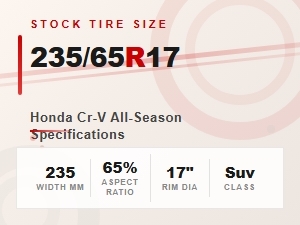 Honda Cr-V Stock Tire Size and Specs – Replacement Options Guide
 Best All-Season Tires for 2005 Honda Cr-V Original Size
 How to Choose the Right Replacement Tires for Your 2005 Honda Cr-V
 Performance Tire Upgrades for Honda Cr-V
 Honda Cr-V Oem Tire Size: Best All-Season Brands Compared and Rated
 Honda Cr-V Factory Tire Size Comparison by Brand Review